


The Language of Mathematics Functions
1 Functions
1.1 Functions
Functions
•A function f from one set X to another set Y is a subset of the Cartesian
product X*Y such that for any x ∈X, there is exactly one y with (x, y)
∈f .
•Denote a function by f : X -> Y
•We usually write f (x) = y if (x, y) ∈f .
•The domain of f : X -> Y is X.
•The range of f : X -> Y is the set {y | (x, y) ∈f for some x ∈X}
Example.
1. f : R -> R given by f (x) = x2 is a function.
2. Let X = {a, b, c} and Y = {v, c}. Then f = {(a, v), (b, c), (c, c)} is a
function.
3. g = {(v, a), (c, b), (c, c)} is not a function. (We call this a relation)
2 Specifying Functions
2.1 Arrow Diagrams
Arrow Diagrams
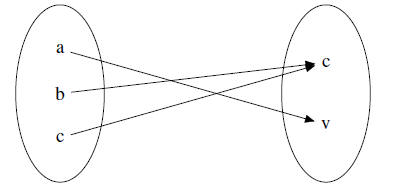
•For small enough functions, we can denote them with an arrow diagram
Example. Let X = {a, b, c}, Y = {v, c} and f = {(a, v), (b, c), (c, c)} as
before.
2.2 Rules
Rules
•You are probably familiar with functions given by rules.
Example. 1. f (x) = x2
2. g(x) = ex
3. h(x) = sin x
2.3 Graphs
Graphs
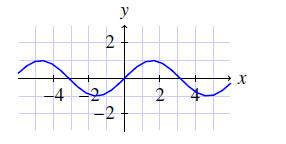
•Suppose that f is a function whose domain and range are both subsets of R.
The graph of f is obtained by plotting each element of f as a point.
Example. The graph of f (x) = sin x
3 Specific Functions
3.1 Modulus Operator
Modulus Operator
•Recall Z denotes the set of integers.
•For x, y ∈Z with y > 0, define x mod y to be the remainder on dividing x
by y.
•x mod y is always nonnegative.
3.2 Floor and Ceiling Functions
Floor and Ceiling Functions
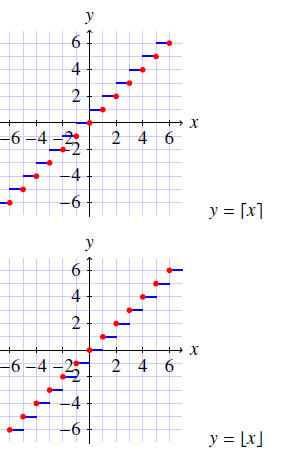
•The ceiling of a number, denoted
 is the least integer greater than or
equal to x. (Round up!)
•The floor of a number, denoted  is the greatest integer less than or equal
to x. (Round down!)
3.3 Operators
Operators
Let X be a set. A binary operator on X is a function X*X -> X (Two
inputs).
Let X be a set. A unary operator on X is a function X -> X.
Example. 1. If X is the set of all propositions in arithmetic, then
 is
is
a unary operator on X.
2. If U is a universal set, then f (A, B) =
 is a binary operator on

3. f (x, y) = 3x - 2y is a binary operator on Z.
4 Properties of Functions
4.1 One-to-One Functions
One-to-One Functions
• A function f is one-to-one (or injective) if for each y ∈Y, there is at
most
one x ∈X with f (x) = y.
4.2 Onto Functions
Onto Functions
• A function f is onto (or surjective) if for each y ∈Y, there is at least
one
x ∈X with f (x) = y.
4.3 Bijective Functions and Inverses
Bijective Functions
•A function f is bijective if it is both one-to-one and onto.
•Bijective functions f have inverses f-1
Inverses
•The inverse f-1 of a bijective function “undoes” f
•Reverses the arrow diagram
Logarithms
•The function f (x) = lg x is the inverse of g(x) = 2x
•Called the base ∈logarithm of x
Example.
1. lg 64 = 6
2. lg 1000 ≈ 9.96578
4.4 Composition of Functions
Composition of Functions
•If g : X -> Y and f : Y -> Z are functions, we can define a new function
 ,
called the composition of f with g.
,
called the composition of f with g.
•Perform g, then f .
•The target of g and the domain of f must agree.
5 Hashing
5.1 Hashing
Hashing
•Want to organize stored data so that retrieval is efficient.
– Determine whether a particular item has been stored
– Edit or delete a particular item
– Find a place to insert a new item
•Hash tables are a commonly used method
– Have a hash function h : {Data} -> {Memory Locations}
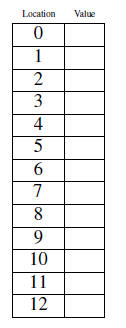
Suppose we have 6 students in a computing class, with student IDs:
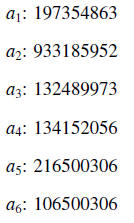
We also have 13 memory locations, indexed 0 to 12.
Define a hash function by h(x) = x mod 13.
Suppose we now have 8 students in a computing class, with student IDs:
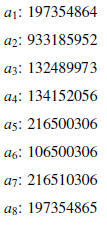
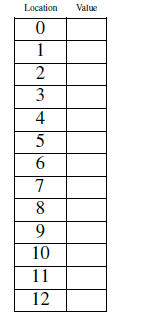
We may end up having a collision, i.e., two or more items trying to be placed
in the same position.
We need a collision resolution policy. One simple one is simply to move to the
next unoccupied
location.
Summary
Summary
You should be able to:
•Use functions and basic function terminology
•Identify functions using different methods
•Use the modulus operator and lg x
•Understand one-to-one and onto functions
•Understand and use hashing functions
•Deal with hashing collisions