
Home
Equations with Parentheses
Homework 6 Integration
math final exam
Radial basis functions for simulating PDEs
Mahtematics Courses
Inverse Functions
Polynomial Division;The Remainder and Factor Theorems
MATH 120 Exam 1 Information
Evaluating Variable Expressions
Basic Mathematics Skills
Lexical templates at the base of the layered architecture of the LCM
Developmental Mathematics Course Information
Facts to Remember
Quadratic Function
Assessment Sample Question for M
Math 100 Study Guide for the Fin
Math Standards
INTERMEDIATE ALGEBRA
Factoring Polynomials
Precalculus I
Greek Numbers and Arithmetic
Precalculus Course Outline
beginalgebra_contents
Math 2700 Key Concepts
MATH 215 Linear Algebra
Elementary Linear Algebra Autumn 2008
Singular Values
Linear Equations in Two Variables
A catalog of essential functions
Partial Fractions,Long Division
MATH 128-003 Exam
Math 150 Final Exam Review
College Algebra
Polynomial equations and solving them
MTH 098
Information and Entropy
Intermediate Algebra EXPONENTS
Linear Equations and Inequalities
Linear Equations in Two Variables
GRAPHING LINEAR EQUATIONS IN TWO VARIABLES
Literal Equations Practice
ITERATIVE METHODS FOR SOLVING LINEAR EQUATIONS
Foundations of Advanced Mathematics
Intermediate Algebra
Calculus I:Sample Exam 4
FACTORING EXPRESSIONS INVOLVING RATIONAL EXPONENTS
Properties of Logarithms
Math 1051 Pre-calculus I Lecture Notes
Intermediate Algebra
HOMEWORK 05 SELECTED SOLUTIONS
Mathematics Problem Solving
MATH 10 - COLLEGE MATHEMATICS
MATH OBJECTIVES
NUMBER - RATIONAL NUMBERS
Literal Functions and Formulas
MATH 104 Beginning Algebra
Intermediate Algebra
Factoring Expressions
Introduction to rational functio
The Language of Mathematics Functions
Sample Test Problems for Mathematics
MATH 097 Developmental Math
Solving Equations & Inequalities
Review of Chapter 1
Inverse Functions Facts
Matrix Operations on a Casio Graphing Calculator
Adding & Subtracting Fractions
Engineering-Calculus-1
Math 444 Homework 4
Exponential Functions
ALGEBRA SUGGESTED HOMEWORK AND COURSE OBJECTIVES
Mathematics
Applications of Matrices and Linear Algebra
Math Courses
GEOMETRY DEFINITIONS
Differential and Integral Calculus Review and Tutorial
Linear Equations
Polynomial Functions
LINEAR ALGEBRA
INTERMEDIATE ALGEBRA
Adding and Multiplying Fractions
MTH 125 - Finite Mathematics
Intermediate Algebra
Algebra A Class
Math 130 Midterm Examination
INTERMEDIATE ALGEBRA
Subtracting Mixed Numbers
Simplification, Multiplication and Division of Rational Expressions
MATH 120 PREREQUISITE SKILLS
Functions II
INTERMEDIATE ALGEBRA
Calculus 1
Perimeter, Area, and Volume
MATH 701 Quadratics Solutions
Math 131 Test questions
The St. Louis Gateway Arch
Algebra II A
Addition and Subtraction of Rational Numbers
Linear Equations and Formulas

Linear Equations and Formulas

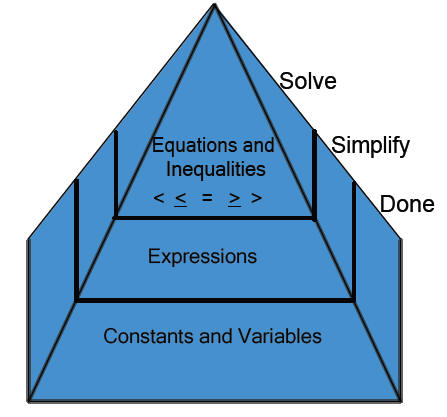
The Algebra Pyramid
Definitions:
Solution: A number that makes an
equation true when it replaces the
variable in the equation.

Solution set: A set containing all the
solutions for a given equation.

Linear equation in one variable: An
equation with only one variable; the
variable is not raised to a power.

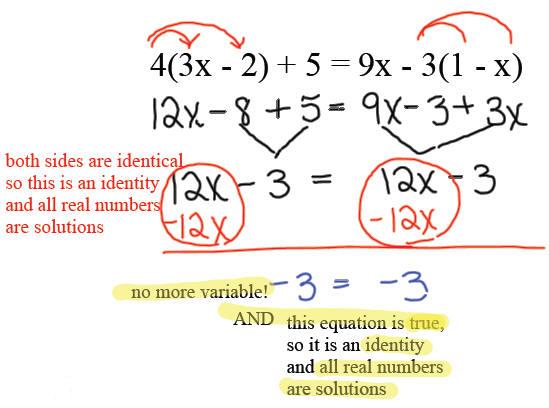
Identity: An equation in which every real
number (for which the equation is
defined) is a solution.

Contradiction: An equation that has no
solution.

Addition Principle of Equality:
If a=b, then a+c=b+c is true for all real numbers a, b, and c.
(If an equation is true and the same number is added to both sides, the equation is still
true.)

Multiplication Principle of Equality:
If a=b, then ac=bc is true for all real numbers a, b, and c, where c=0.
(If an equation is true and both sides are multiplied by the same number, the equation
is still true.)

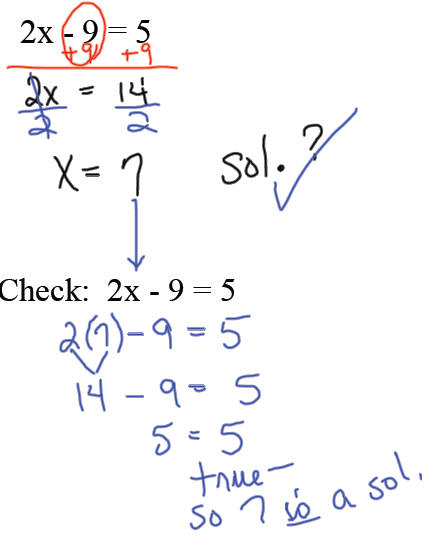
Pattern for solving linear equations in 1 variable:

Get it READY to solve:
1. Distribute to clear parentheses
2.Multiply to clear fractions and decimals
3. Combine like terms.

Now it is ready, so SOLVE it:
1. Get variable on only one side
using addition principle
2. Get constants on the other side
using addition principle
3. Eliminate the coefficient of the variable
using multiplication principle.

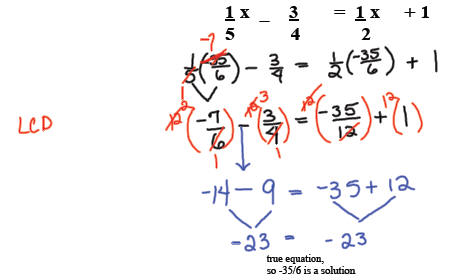
Now you've solved it, so CHECK it.
1. Substitute the possible solution for the variable
2. Simplify both sides
3. If the result is true, it is a solution
If the result is false, it is not a solution.

solve
solve
solve
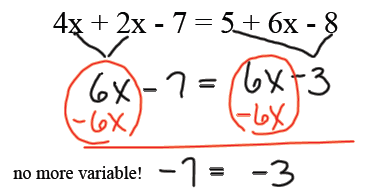
AND this equation is FALSE
so this is a contradiction and
has no solution

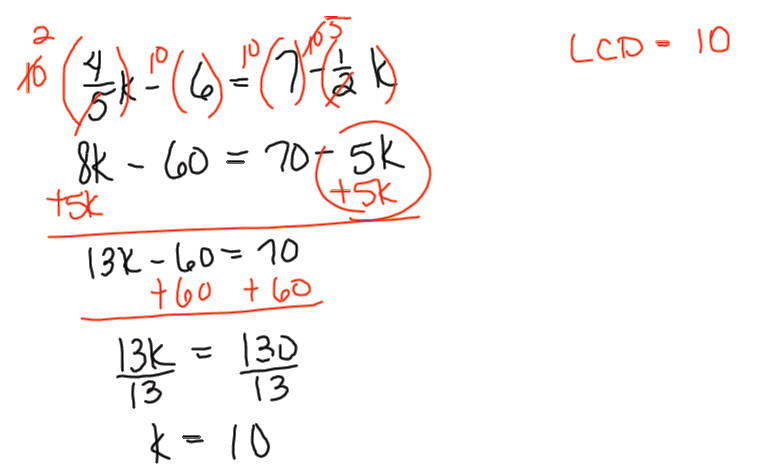
Pattern for clearing fractions:
1. Find one LCD for the entire equation.
2. Multiply every term in the entire equation
by that LCD, even if the term does not contain
a fraction. All denominators should cancel out.
3. Solve the remaining equation.
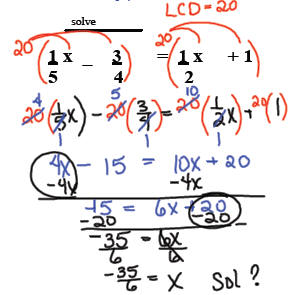
In certain situations you can clear fractions by multiplying by the reciprocal of the fraction.
However, the equation must be in the right form and you must avoid common careless mistakes.
Clearing fractions, as instructed above, will always work.
Pattern for clearing decimals:
1. Find one LCD for the entire equation.
It will be a power of 10.
2. Multiply every term in the entire equation by that LCD,
even if the term does not contain a fraction.
All denominators should cancel out.
3. Solve the remaining equation and check.

Instructions?
0.4 (n - 3) = 0.25n + 6

To isolate a particular variable in a formula:
1. Treat all other variables as constants.
2. Isolate the desired variable using the pattern for solving equations.

P = R - C solve for R
I = Prt  solve for r
P = 2l + 2w solve for w
C = 5/9 (F - 32) solve for F