
Homework 6 Integration
6.2.30. We apply integration by parts letting dv = e-x dx
and u = x2 so
v = -e-x and du = 2x dx. Then,

To simplify  dx we must
apply integration by parts again with dv =
dx we must
apply integration by parts again with dv =
e-x dx and u = x so v = -e-x and du = dx. Then, we have

6.2.34. We apply substitution to simplify the integrand,
letting u = 1+2x
so du = 2 dx and dx = 1/2 du. When x = 0, we have u = 1 + 2(0) = 1 and
when x = 1, we have u = 1+2(1) = 3. Hence, we can rewrite the integral as
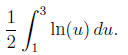
To simplify notation, we rewrite this with u = x so that
we can apply inte-
gration by parts:
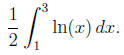
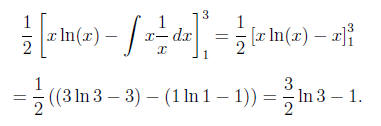
Let dv = dx and u = ln(x) so v = x and du = 1/x dx. Then we have
6.3.18. The integrand is a proper rational function, so we
can find its
partial fraction decomposition as
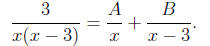
The basic equation is
3 = A(x - 3) + B(x)
which we can solve by plugging in x = 3 to get 3B = 3 so B
= 1 and x = 0
to get -3A = 3 so A = -1. Hence our integral is

Here, we are using that for any constant a. This can
be proved by substitution because when u = x+a, we have du = dx. Notice
that if we integrate dx then we pick up a
sign, and if we integrate
dx then we pick up a
sign, and if we integrate
 then we will pick up a coefficient of 1/b .
6.3.26. The integrand is a proper rational function and
the denominator
factors as x(x2 - 1) = x(x - 1)(x + 1), so we can find its partial fraction
decomposition as

The basic equation is

which we can solve by plugging in x = 1 to get 2B = 3 - 7
- 2 = -6 so
B = -3 and x = -1 to get 2C = 3 + 7 - 2 = 8 so C = 4 and x = 0 to get
-A = -2 so A = 2. Hence our integral is

6.3.30. The integrand is not proper, so we must rst
perform long division
on the rational function. We obtain

We find the partial fraction decomposition of the remainder as

and the basic equation is

Comparing the coefficients of x2 on both sides, we have A
= 6. Comparing
the coefficients of x on both sides, we have B-2A = -8 so B = 4. Comparing
the coefficients of 1 on both sides, we have C -B + A = 3 so C = 1. Hence,
our integral becomes
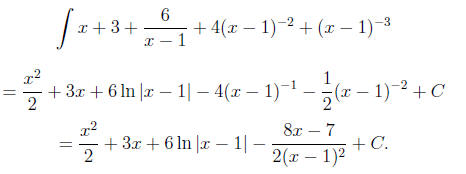
6.3.38. The integrand is not proper, so we must first
perform long division
on the rational function. We obtain
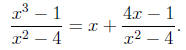
We factor the denominator of the remainder as a difference
of squares x2-4 =
(x - 2)(x + 2) and find the partial fraction decomposition of the remainder
as
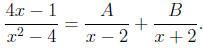
The basic equation is

and we plug in x = -2 to obtain -4B = -9 so B = 9/4 as
well as x = 2 to
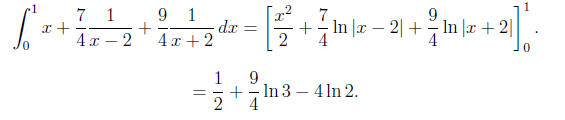
obtain 4A = 7 so A = 7/4 . Hence, our integral becomes
6.3.44. We begin by determining where the curve meets the
x-axis by
solving  for x. In order for this fraction to
be zero, we must have
for x. In order for this fraction to
be zero, we must have
that the numerator is zero (and the denominator is non-zero). Hence, we
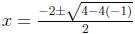
solve x2 + 2x - 1 = 0 using the quadratic formula, so
 The
The
positive root occurs at (This turns out to be
about 0.41.) Notice
(This turns out to be
about 0.41.) Notice
that the denominator x2 - 4 does not vanish at this root, so the function is
well-defined at 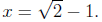
By definition, the area under this curve is
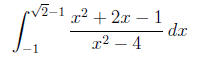
which we need partial fractions to solve. The integrand is
not proper so we
must first perform long division to obtain
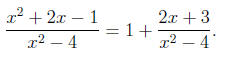
The denominator of the remainder factors as a di erence of
squares (x2-4) =
(x - 2)(x + 2) and so the partial fraction decomposition is
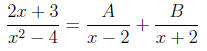
with basic equation

Plugging in x = -2 we get -4B = -1 so B = 1/4 and x = 2
gives 4A = 7 so
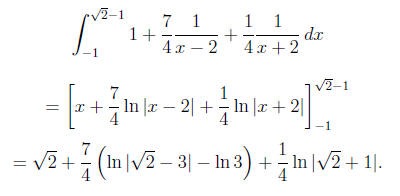
A = 7/4 . Hence, our integral becomes