
Information and Entropy
Solution to Problem 1: Is it Over-Compressed or is it
Modern Art?
The following MATLAB code solves parts a to e:
% Perform initialization as indicated in the problem set.
load imdemos flower;
flower=double (flower);
colormap (’gray’);
% Since many figures will be produced by this script, we use meaningful labels.
set(gcf,’NumberTitle’,’off’,’Name’,’Flower’); imshow (flower,[0 255]);
% Implement the comrpession scheme detailed in the problem set.
encoded=blkproc (flower,[8 8],’dct2’);
encoded(abs (encoded)<10)=0;
decoded=round(blkproc (encoded,[8 8],’idct2’));
% Provide the error value to check against the expected value from the set.
sprintf (’With cutoff=10, the mean squared error is %.4f’, ... mean2((flower
decoded).∧2))
The mean squared error you should have obtained is 10.6891. The next piece of
code produces the graph
of file size versus mean squared error.
% Initialize the vectors that will store the data for the
graph.
x=[];
y=[];
% We need only encode the image once. After that, since we will be steadily
% increasing the threshold, we need to reconvert again more because we will be
% simply zeroing-out more elements with each iteration through the for loop
% (there is no reason to recover all the original elements and start from
scratch
% each time through the loop; we can progressively drop more and more data).
encoded=blkproc (flower,[8 8],’dct2’);
% Now we begin to collect data for the graph.
for cutoff=0:4:100,
encoded(abs (encoded)<cutoff)=0;
decoded=round (blkproc (encoded,[8 8],’idct2’));
% We will simply append to the vectors each time through this loop.
x=[x,nnz (encoded)];
y=[y,mean2((flower decoded).∧2)];
% The next three lines can be commented out if they are not desired. They
% will produce a new window, label it, and print a representation of the
% newly decoded image for each cutoff threshold. This is for comparison
% with the original image to answer the question in the set that asks at
% which point the difference between the original image and the compressed
% image becomes perceptible to the human eye.
figure;
set (gcf,’NumberTitle’,’off’,’Name’,sprintf(’cutoff=%d’, cutoff)); imshow
(decoded,[0 255]);
end
% Now, plot the graph with a smooth curve and boxes around all the actual data
points.
figure;
set (gcf,’NumberTitle’,’off’,’Name’,’Graph for Problem 1’);
plot(x,y,’s’)
title(’Comparison of File Size and Image Error’);
xlabel (’Nonzero matrix values (number of bytes to store)’);
ylabel (’Mean squared error’);
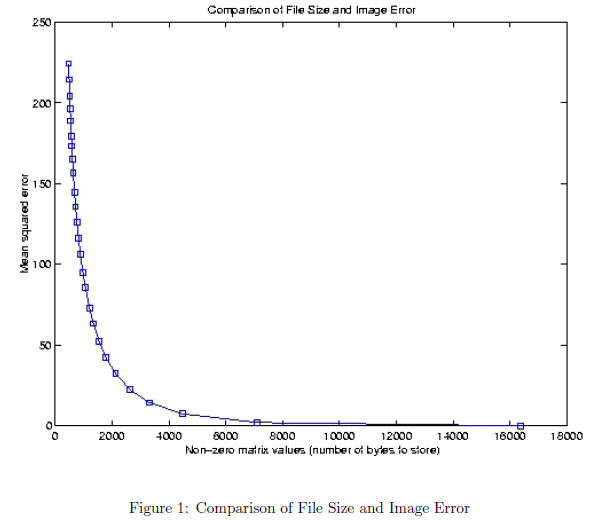
You should have gotten something remotely resembling the
graph in Figure 1. As you can see, there
is a point where the MSE increases exponentially giving a quantitative value to
the degradation of the
reconstructed picture. Medical applications such as in Xrays tend to discourage
the use of JPEG or similar
lossy compression algorithms for saving images due to chances of distortion
leading to an incorrect diagnosis.
The largest byte size for which I could detect the difference between the
original image and the recon-
structed image by eye was 1,785 bytes, which corresponds to a cutoff of 24 and a
mean square error of
42.2132. This is rather remarkable because the image started out over 16kb long,
which means that less that
an eighth of the data recorded is actually necessary to create the visual effect
we experience when looking
at the picture. Beyond that, the quality is not horrible, either, but we can
begin to detect bands forming
due to the fact that the pixels were processed as distinct 8 × 8 blocks. By the
end of the experiment, where
the cutoff is 100, the picture is not good, yet there is still enough data that
it is recognizable as a flower and
shows a resemblance to the original image.
Solution to Problem 2: Compression is Fun and Easy
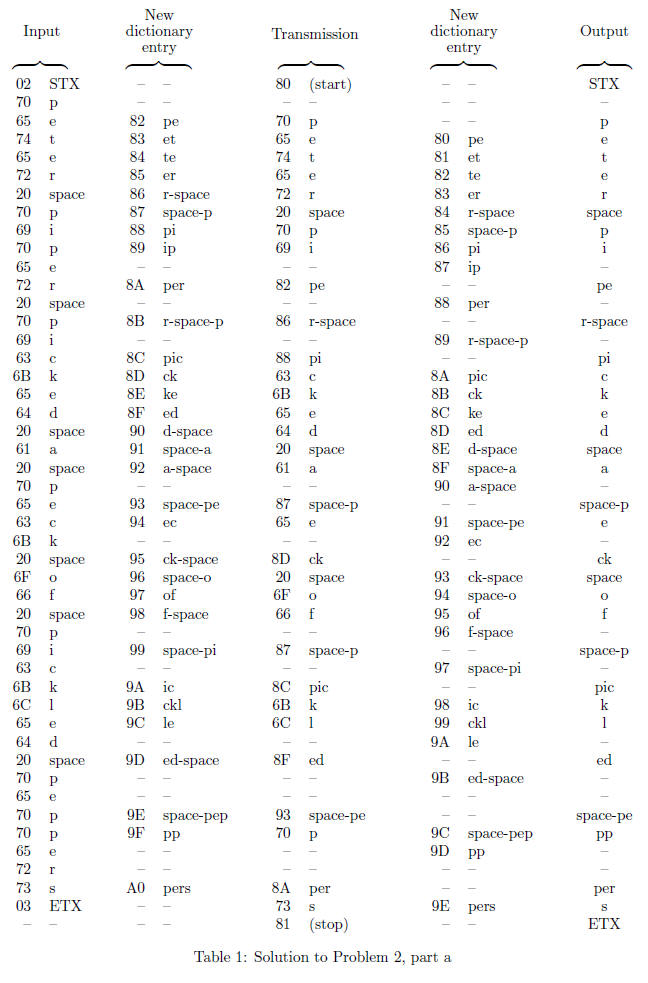
Solution to Problem 2, part a.
Table 1 represents the LZW analysis of the phrase “peter piper picked a peck of
pickled peppers.” The
resulting data stream is:
80 70 65 74 65 72 20 70 69 82 86 88 63 6B 65 64 20 61 87 65 8D 20 6F 66 87 8C 6B
6C 8F 93 70
8A 73 81
This is 34 bytes long, whereas the original message was 46 bytes long (including
the start and stop control
characters), which amounts to 26.1% compression. If we count bits, the original
message could have been
sent in 7 bits per character (total 322 bits) whereas the LZW code requires 8
bits per character (total 272
bits) so the compression is 15.5%. Of course, this is a short example but
contrived to make the dictionary
grow quickly. For a sizeable selection of average English text, LZW typically
yields 50% compression.
Solution to Problem 2, part b.
This strategy has several advantages: we will stay within 7-bit data, hence more
compression and faster
encoder/decoder; moreover, the dictionary can be searched quickly. There is a
major drawback, though.
The dictionary can only have 16 entries beyond the ASCII characters. Except for
very short and repetitive
sequences of characters, the dictionary will overflow. Another drawback is that
the text cannot include any
of the ASCII characters being used for the dictionary; among the characters
excluded are three that are
often used (DC1, DC3, and ESC). On the other hand, the characters HEX 80 -FF
would now be available
since the dictionary no longer is there, and this includes many common accented
letters of Western European
languages. A practical implementation of the coder and decoder would not be
either easier or harder by
very much, but new programs would have to be written because this proposed
arrangement is not standard,
and new software always brings with it a cost and risk of bugs.