
Home
Equations with Parentheses
Homework 6 Integration
math final exam
Radial basis functions for simulating PDEs
Mahtematics Courses
Inverse Functions
Polynomial Division;The Remainder and Factor Theorems
MATH 120 Exam 1 Information
Evaluating Variable Expressions
Basic Mathematics Skills
Lexical templates at the base of the layered architecture of the LCM
Developmental Mathematics Course Information
Facts to Remember
Quadratic Function
Assessment Sample Question for M
Math 100 Study Guide for the Fin
Math Standards
INTERMEDIATE ALGEBRA
Factoring Polynomials
Precalculus I
Greek Numbers and Arithmetic
Precalculus Course Outline
beginalgebra_contents
Math 2700 Key Concepts
MATH 215 Linear Algebra
Elementary Linear Algebra Autumn 2008
Singular Values
Linear Equations in Two Variables
A catalog of essential functions
Partial Fractions,Long Division
MATH 128-003 Exam
Math 150 Final Exam Review
College Algebra
Polynomial equations and solving them
MTH 098
Information and Entropy
Intermediate Algebra EXPONENTS
Linear Equations and Inequalities
Linear Equations in Two Variables
GRAPHING LINEAR EQUATIONS IN TWO VARIABLES
Literal Equations Practice
ITERATIVE METHODS FOR SOLVING LINEAR EQUATIONS
Foundations of Advanced Mathematics
Intermediate Algebra
Calculus I:Sample Exam 4
FACTORING EXPRESSIONS INVOLVING RATIONAL EXPONENTS
Properties of Logarithms
Math 1051 Pre-calculus I Lecture Notes
Intermediate Algebra
HOMEWORK 05 SELECTED SOLUTIONS
Mathematics Problem Solving
MATH 10 - COLLEGE MATHEMATICS
MATH OBJECTIVES
NUMBER - RATIONAL NUMBERS
Literal Functions and Formulas
MATH 104 Beginning Algebra
Intermediate Algebra
Factoring Expressions
Introduction to rational functio
The Language of Mathematics Functions
Sample Test Problems for Mathematics
MATH 097 Developmental Math
Solving Equations & Inequalities
Review of Chapter 1
Inverse Functions Facts
Matrix Operations on a Casio Graphing Calculator
Adding & Subtracting Fractions
Engineering-Calculus-1
Math 444 Homework 4
Exponential Functions
ALGEBRA SUGGESTED HOMEWORK AND COURSE OBJECTIVES
Mathematics
Applications of Matrices and Linear Algebra
Math Courses
GEOMETRY DEFINITIONS
Differential and Integral Calculus Review and Tutorial
Linear Equations
Polynomial Functions
LINEAR ALGEBRA
INTERMEDIATE ALGEBRA
Adding and Multiplying Fractions
MTH 125 - Finite Mathematics
Intermediate Algebra
Algebra A Class
Math 130 Midterm Examination
INTERMEDIATE ALGEBRA
Subtracting Mixed Numbers
Simplification, Multiplication and Division of Rational Expressions
MATH 120 PREREQUISITE SKILLS
Functions II
INTERMEDIATE ALGEBRA
Calculus 1
Perimeter, Area, and Volume
MATH 701 Quadratics Solutions
Math 131 Test questions
The St. Louis Gateway Arch
Algebra II A
Addition and Subtraction of Rational Numbers
Linear Equations and Formulas

Partial Fractions, Long Division

A rational expression is a quotient of polynomials, i.e. has the form

At first sight, rational expressions are difficult to integrate. However, the
algebraic techniques of partial fraction expansion and long division can be used
to make these complex expressions simpler.

1.1 Partial fraction expansion

Word of Warning: Our method here applies when the denominator has linear,
nonrepeated factors only. This will be sufficient for our Calc II class, but some
of you will see more sophisticated methods in other classes.

Partial fractionsworks when the largest power of the numerator is smaller
than the largest power of the denominator. Here are the instructions. Start
with a rational expression:

First, completely factor the bottom polynomial:

Second, break up the fraction so that the factors of the bottom become the
denominators of individual fractions, with (as of yet) unknown constants in
the numerators:

Third, figure out what the constants are.

Example 1 Use partial fraction expansion to simplify

Solution We simply follow the instructions laid out above:
First, factor the bottom:

Second, break up the fraction

Third, figure out what A1 and A0 are:
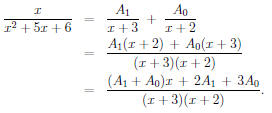
Thus x = (A1 +A0)x + 2A1 + 3A0, so that A1 +A0 = 1 and 2A1 +3A0 = 0.
We can solve these two equations, to get A1 = 3, A0 = -2. Thus finally

Example 2 Evaluate
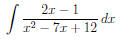
Solution The fraction is too tough to evaluate, so we have to use partial fraction
expansion to simplify it.
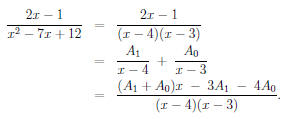
Thus A1 + A0 = 2 and -3A1 - 4A0 = -1. We can solve this to get A1 = 7,
A0 = -5. Therefore

Now we can solve our calculus problem:

1.2 Long Division

Long division (or synthetic division) can be used when the highest power on
top is equal to or larger than the highest power on bottom.

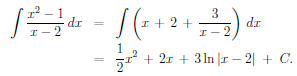
Example 3 Evaluate

Solution The fraction is too tough to evaluate directly. Since the top power is
bigger, we have to use long division. Using the long division process (which
we discussed in class), we get
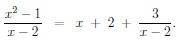
Note: you can also use synthetic division to arrive at this conclusion. Now we
can solve our calculus problem: