
Polynomial Functions
Definition of a Polynomial Function
Let n be a nonnegative integer and let
 be real numbers, with
 .
.
The function defined by
 is called a polynomial function of x
of degree n. The number an , the coefficient of the variable to the highest
power, is called the
leading coefficient.
Note: The variable is only raised to positive integer powers–no negative
or fractional exponents.
However, the coefficients may be any real numbers, including fractions or
irrational numbers
like π or .
.
Graph Properties of Polynomial Functions
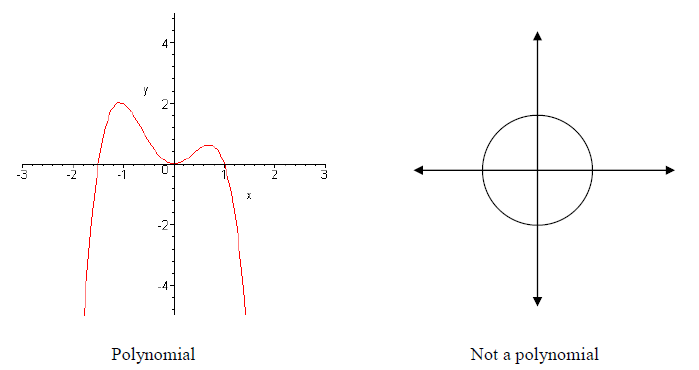
Let P be any nth degree polynomial function with real coefficients.
The graph of P has the following properties.
1. P is continuous for all real numbers, so there are no breaks, holes, jumps in
the graph.
2. The graph of P is a smooth curve with rounded corners and no sharp corners.
3. The graph of P has at most n x-intercepts.
4. The graph of P has at most n – 1 turning points.
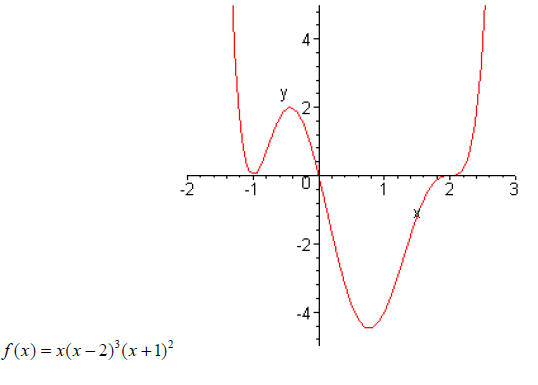
Example 1: Given the following polynomial functions, state the leading
term, the degree of the
polynomial and the leading coefficient.
a. P(x) = 7x4 - 5x3 + x2 - 7x + 6
b. P(x) = (3x + 2)(x - 7)2 (x + 2)3
End Behavior of a Polynomial
Odd-degree polynomials look like y = ±x3 .
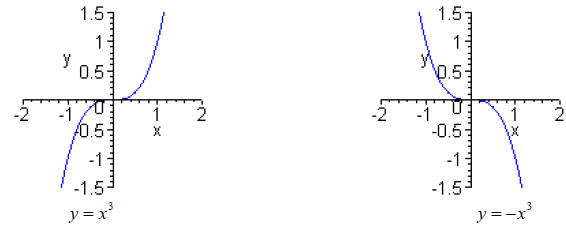
Even-degree polynomials look like y = ±x2 .
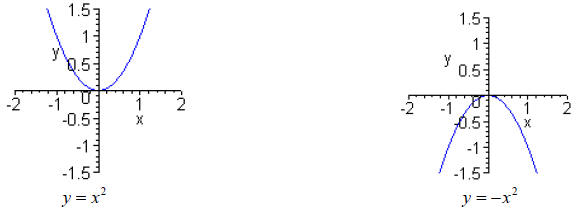
Power functions:
A power function is a polynomial that takes the form f (x) = axn ,
where n is a positive integer.
Modifications of power functions can be graphed using transformations.
| Even-degree power functions: f (x) = x4 |
Odd-degree power functions: f (x) = x5 |
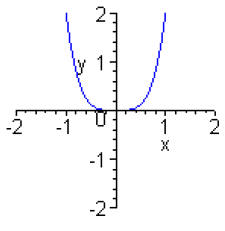 |
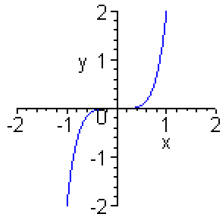 |
Note: Multiplying any function by a will multiply
all the y-values by a. The general shape will
stay the same. Exactly the same as it was in section 3.4.
Zeros of a Polynomial
If f is a polynomial and c is a real number for which f (c) = 0, then c is
called a zero of f, or a
root of f.
If c is a zero of f, then
· c is an x-intercept of the graph of f.
· (x - c) is a factor of f.
So if we have a polynomial in factored form, we know all of its x-intercepts.
· every factor gives us an x-intercept.
· every x-intercept gives us a factor.
Example 1:
Find the zeros of the polynomial:
P(x) = x3 - 5x2 + 6x
Example 2: Consider the function f (x) = -3x(x - 3)4 (5x -
2)(2x -1)3(4 - x)2 .
Zeros (x-intercepts):
To get the degree, add the multiplicities of all the factors:
The leading term is:
Behavior at Intercepts:
Near an x-intercept, c, the shape of the function is determined by the factor
(x-c) and the power
to which it is raised.
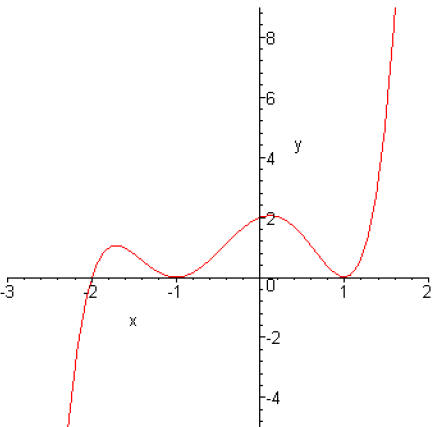
Let’s look again at the graph on the first page
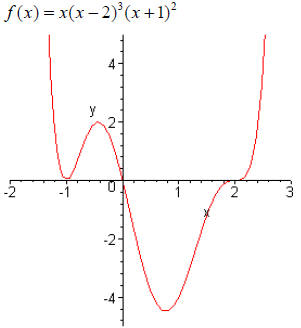
Notice the shape of the graph as it crosses the x-axis at
each intercept.
Definition: The multiplicity of a factor in a polynomial function is the power
to which it is
raised in the fully factored form of the polynomial. The multiplicity of the
factor (x-c) with
no higher power is 1.
Compare the multiplicities of the factors in the above polynomial with the shape
at each
corresponding intercept.
The graph of P(x) = (x - c)k looks like the function f (x) = xk
near the x-intercept c. Since we
know the shape of a power function, we have the following rules:
· Even multiplicity: touches x-axis, but doesn’t cross (looks like a parabola
there).
· Odd multiplicity of 1: crosses the x-axis (looks like a line there).
· Odd multiplicity ≥3 : crosses the x-axis and looks like a cubic there.
Steps to graphing other polynomials:
1. Find the y-intercept by finding P(0).
2. Factor and find x-intercepts.
3. Mark x-intercepts on x-axis.
4. For each x-intercept, determine the behavior.
· Even multiplicity: touches x-axis, but doesn’t cross (looks like a parabola
there).
· Odd multiplicity of 1: crosses the x-axis (looks like a line there).
· Odd multiplicity ≥3 : crosses the x-axis and looks like a cubic there.
Note: It helps to make a table as shown in the examples below.
5. Determine the leading term.
· Degree: is it odd or even?
· Sign: is the coefficient positive or negative?
6. Determine the end behavior. What does it “look like”?
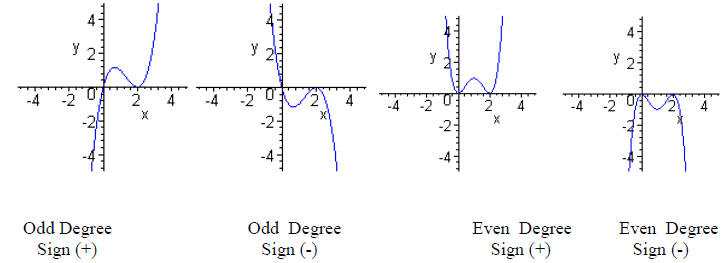
7. Draw the graph, being careful to make a nice smooth
curve with no sharp corners.
Note: without calculus or plotting lots of points, we don’t have enough
information to know how
high or how low the turning points are.
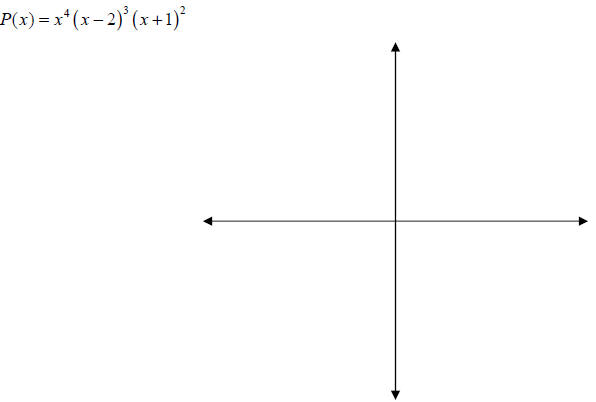
Example 3:
Find the zeros then graph the polynomial. Be sure to label the x intercepts, y
intercept if
possible and have correct end behavior.
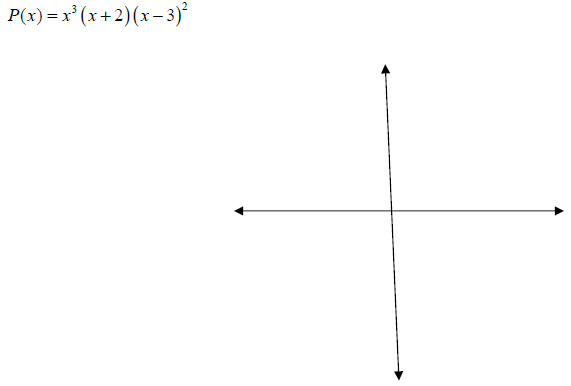
Example 4:
Find the zeros then graph the polynomial. Be sure to label the x intercepts, y
intercept if
possible and have correct end behavior.
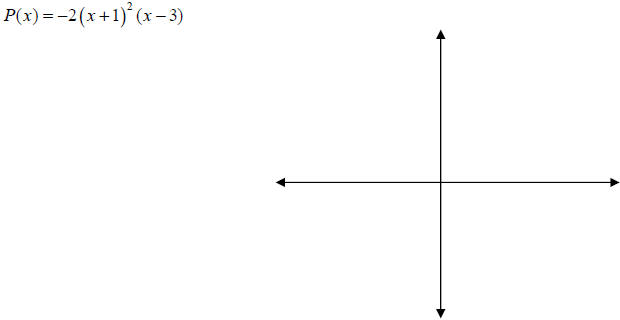
Example 5:
Find the zeros then graph the polynomial. Be sure to label the x intercepts, y
intercept if
possible and have correct end behavior.
Example 6:
Find the zeros then graph the polynomial. Be sure to label the x intercepts, y
intercept if
possible and have correct end behavior.
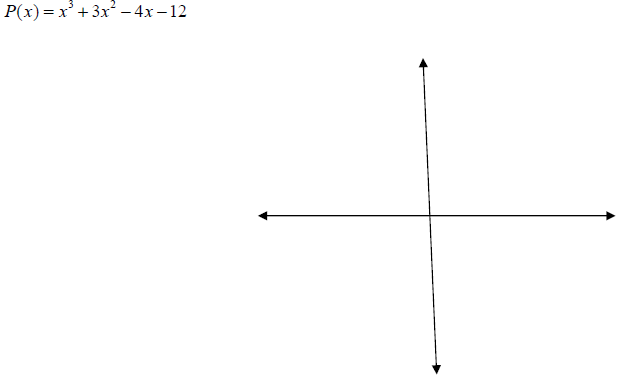
Example 7:
Given the graph of a polynomial determine what the equation of that polynomial.
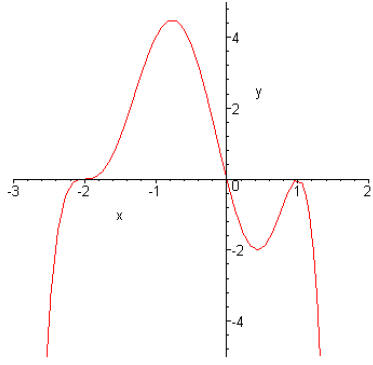
Example 8:
Given the graph of a polynomial determine what the equation of that polynomial.